
A cabinet thermostat is a temperature-operated switch, not a process controller. It opens or closes its contacts at a set temperature to control a heater, cooling fan, or alarm.
Two main types of thermostats are used in electrical enclosures. They serve similar purposes but differ in how they operate. These differences can affect which type is best suited to an application.
Before choosing a model, it is important to check its switching behavior, temperature range, and electrical ratings. These details help ensure the thermostat meets the requirements of the enclosure.
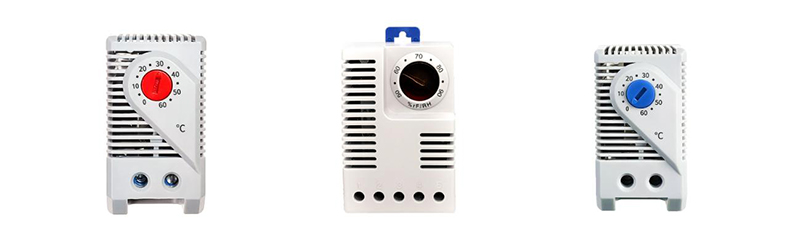
What a cabinet thermostat actually controls
The device does not control enclosure temperature in the way a building management system controls a room. It controls one output at one threshold, and what happens after that output changes depends on what is connected to it and how the enclosure loses heat. The difference between temperature and humidity control is covered separately in thermostat versus hygrostat for panels, and the heating side of the calculation in anti-condensation heater sizing.
Normally open and normally closed contacts
A normally open device holds its contact open at rest and closes as temperature rises, which is what a cooling fan or an alarm needs. Reversed logic closes as temperature falls, which suits a heater such as the KTO013 cabinet heater thermostat. Contact logic is not interchangeable, and a thermostat ordered with the wrong logic runs the load in the opposite direction to the one intended.
The ratings that separate the two families
A thermostat’s switching behavior depends on its setpoint and switching difference. The setpoint is the temperature at which the contact changes state.
The switching difference is the temperature change needed for the contact to return to its original state. Both values are important when checking a thermostat’s specifications. They should be considered together when selecting a model.
| Parameter | What to Check |
|---|---|
| Switching difference and tolerance | How far the temperature moves between on and off, and how far the actual value deviates from the published figure |
| Contact configuration | Normally open, normally closed or change-over, and whether one device serves both heating and cooling |
| Maximum switching capacity | Resistive and inductive ratings separately, at the voltage actually being switched |
| Maximum inrush current | Whether the contact absorbs the starting current of a fan motor or a capacitive load |
| Sensor element and reaction time | How quickly the device senses a change, and how that delay interacts with the thermal mass of the enclosure |
| Rated life | The number of cycles the contact is declared for at the rated load |
Switching difference and tolerance
Switching difference, also known as hysteresis, is the temperature gap between when a thermostat switches and when it switches back.
A wider switching difference means fewer switching cycles but greater temperature changes inside the enclosure. A narrower difference keeps the temperature closer to the setpoint. However, it also causes the heater or fan to switch on and off more frequently.
Switching difference tolerance is another factor to check. For example, a thermostat rated at 7 K with a tolerance of ±4 K may have an actual switching difference between 3 K and 11 K. This range should be considered when choosing a thermostat for a specific heating or cooling application.
Contact rating, load type and inrush
Published switching capacity leads with a resistive figure. Fan motors and transformers present inductive loads, and the inductive rating on the same device is lower. Inrush is the third factor. Switching a fan directly means the contact has to close onto the starting current, which is why inrush is quoted separately and for a defined duration.
Sensor element and reaction time
Bimetal devices respond through the expansion of a metal element, so the response is slower and mechanically damped. Electronic devices respond through a sensor and a comparison circuit, with the reaction time published as a figure. Large thermal mass makes the difference matter less, and a small enclosure with a fast-changing load makes it matter more.
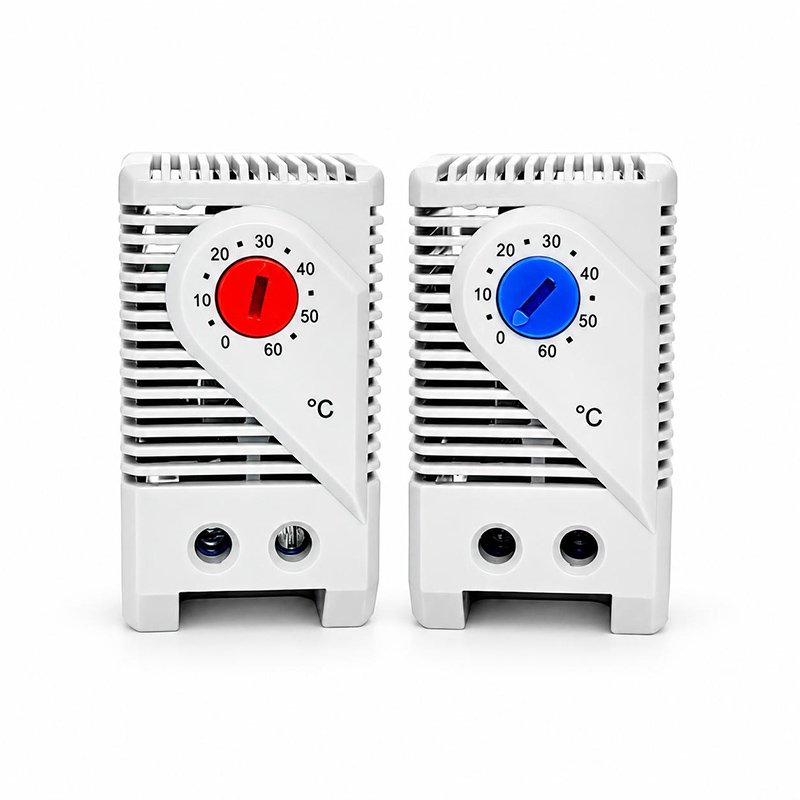
Comparing representative NOXT models
The table sets out published figures for one mechanical and one electronic model from the NOXT product range. Both are DIN rail devices with IP20 protection for the same mounting position inside a cabinet.
| Item | Mechanical KTS011 | Electronic ETF012 |
|---|---|---|
| Switching difference | 7 K with ±4 K tolerance | 2 K with ±1 K tolerance at 25 °C and 50 %RH |
| Humidity switching | Not applicable | 4 %RH with ±1 % tolerance |
| Sensor element | Thermostatic bimetal, snap action | Electronic sensor with relay output |
| Contact type | Normally open for cooling | Change-over relay contact |
| Maximum switching capacity | 10 A resistive or 2 A inductive at AC 250 V on the NC contact, 5 A resistive on the NO contact | 10 A resistive or 1.6 A inductive at AC 240 V, 0.6 A at DC 60 V |
| Maximum inrush current | AC 16 A for 10 seconds | AC 30 A for 10 seconds |
| Rated life | More than 100,000 cycles | More than 30,000 cycles |
| Operating temperature | -45 to +80 °C | -40 to +60 °C |
| Dimensions and weight | 75 × 33 × 43 mm, 50 g | 85 × 60 × 40 mm, 100 g |
Practical differences between mechanical and electronic thermostats
Mechanical thermostats can operate across a wider ambient temperature range. They also offer a longer rated contact life and require no external power supply.
Electronic thermostats provide more precise temperature control with a narrower switching difference. Some models can also monitor humidity and handle higher inrush currents.
The right choice depends on the application. A mechanical thermostat is often sufficient for basic fan control where larger temperature swings are acceptable. For applications that need tighter temperature control or humidity monitoring, an electronic thermostat may be more suitable.
Environmental and mounting constraints
DIN rail mounting and enclosure space
Both families mount on 35 mm DIN rail and occupy a single rail position in most configurations. Electronic units are deeper and heavier, which matters where rail space is shared with terminal blocks or door clearance is tight. The dimension drawing should be checked against the rail layout, not against enclosure volume.
Ambient limits and hazardous areas
The operating range on a datasheet describes the ambient around it, not the setpoint range. A mechanical thermostat rated to +80 °C sits in a hot cabinet that an electronic device rated to +60 °C cannot tolerate. In a declared explosive atmosphere the device itself has to carry the certification, and the ATEX certified thermostat is the model to specify.
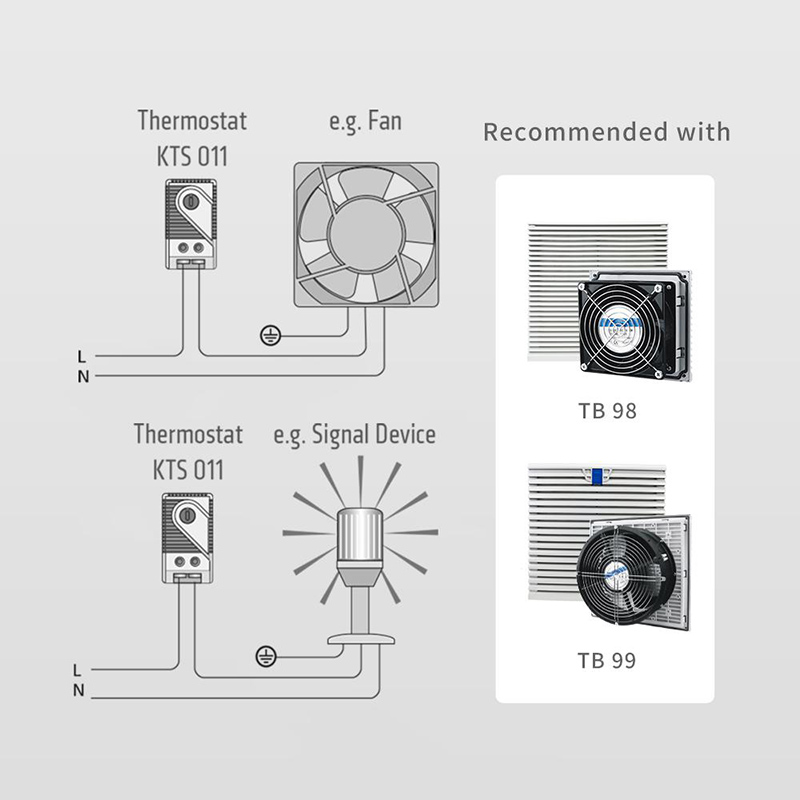
How to choose the right cabinet thermostat
Set the contact function, then the difference
Decide whether the output drives heating or cooling and select normally closed or normally open. Where both functions are required, a dual thermostat provides two independent setpoints in one housing. Heaters with a large thermal mass accept a wide switching difference, while fans cooling a dense electronics stack need a narrow one.
Check the load and the ambient, not the setpoint
Read the inductive and inrush figures, not only the resistive figure, because a directly switched fan needs the higher inrush of the electronic model. Then compare the operating range with the measured cabinet temperature and confirm rail space.
Common specification mistakes
Frequently asked questions
Can a mechanical thermostat control humidity?
No. Bimetal devices respond to temperature only, and humidity control requires a hygrostat or a combined electronic controller.
Does a tighter switching difference always improve the result?
It improves setpoint stability and raises the switching cycle count, so contact life has to be checked against the expected cycles.
Can one thermostat serve both a heater and a fan?
Change-over contacts drive either direction, and a dual thermostat provides two independent setpoints. The two functions should not share one contact.
Is the operating range the same as the setpoint range?
No. The operating range describes the ambient the device survives, while the setpoint range describes the temperatures at which it switches.
What happens if a contact is switched beyond its inductive rating?
Contact erosion accelerates and the declared cycle life no longer applies. Failure appears as a contact that welds closed, not one that opens.
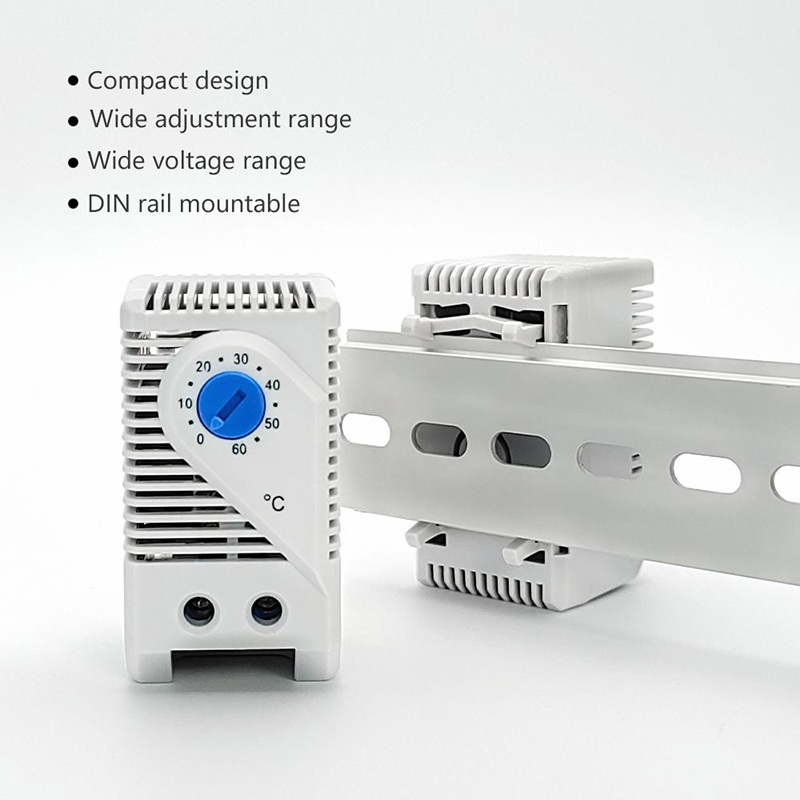
Conclusion
Choosing between a mechanical and an electronic cabinet thermostat involves more than checking the setpoint range. Contact function, switching difference, and its tolerance all need attention. The load’s inductive and inrush current requirements also matter, along with the ambient temperature inside the enclosure.
Two thermostats may have the same setpoint range but perform differently in actual use. Checking these specifications helps ensure the selected model suits the application.
For help with selection, share your cabinet dimensions, connected load, required temperature tolerance, and ambient temperature range. Our engineering team can recommend a suitable model and provide the relevant datasheet and certification documents.